Freehold or Leasehold, inheritance, visa opportunities — what you need to know to buy legally and safely
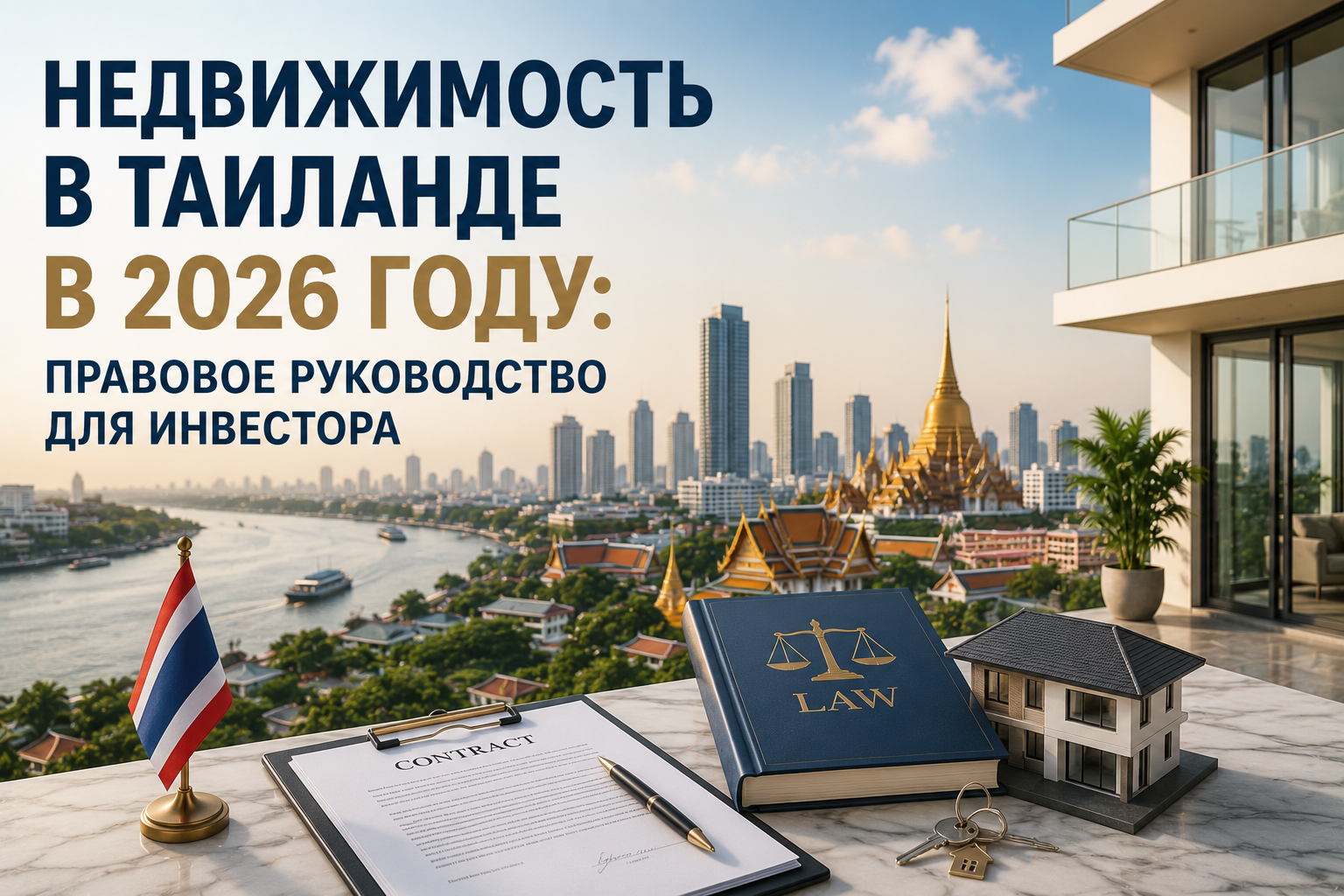
Thailand's property market is entering a period increasingly referred to as the “age of absolute compliance”: government authorities are tightening control over ownership schemes, and it has become essential for investors to choose only transparent, legally sound forms of ownership.
In this article, we break down the key questions: which ownership forms are actually available to foreigners, how Freehold and Leasehold differ, where the risks lie with inheritance, and how a property investment can serve as the basis for a visa strategy.
1) The New Legal Landscape: “Gray Schemes” Are Disappearing
The main change in 2026 is tighter control over how exactly a foreigner owns an asset and on what grounds the paperwork is issued. The focus is on:
- The end of “gray scheme” ownership.
- Stricter scrutiny of nominee Thai companies (so-called nominee structures).
- Increased checks from the Land Department and the Ministry of Commerce.
- A Supreme Court ruling on 90-year leases, which the market interprets as a signal that long, “quasi-ownership” arrangements will face stricter scrutiny.
The takeaway is simple: while some deals used to rely on questionable practices, it's now safer (and often more profitable over a 3–10-year horizon) to stick to formats that pass scrutiny without any “stretching” of the rules.
2) What Ownership Forms Are Available to Foreigners in Thailand
The key rule: foreigners are prohibited from owning land directly (Freehold Land).
But property can still be legally acquired through two basic models:
Option A. Freehold (Full Ownership)
Available to foreigners in registered condominiums, subject to the 49% quota on foreign ownership within a given project.
Option B. Leasehold (Long-Term Lease)
An official right to lease a property for up to 30 years, with the possibility of renewal (per the terms of the contract).
In practice, leasehold is often used for villas, houses, and townhouses, where direct land ownership isn't available to foreigners.
3) Freehold: What It Is and When It's More Advantageous
Freehold means a foreigner buys a condominium unit in their own name and receives perpetual ownership rights.
Advantages of Freehold
- Full ownership: the property can be sold, bequeathed, or mortgaged.
- No time limit (unlike a lease).
- Voting rights at general resident meetings.
- Higher liquidity on resale.
- Lower tax burden compared to many other countries.
Drawbacks and Costs Worth Considering
- A freehold unit is usually 10–15% more expensive than an equivalent leasehold property.
- Registration costs (transfer of ownership, stamp duty, and taxes) — roughly around 6.3% of the property value. These costs are often split evenly between the seller and buyer (depending on the terms of the deal).
Who Freehold suits:
investors for whom ownership rights, maximum liquidity, and a clear inheritance/resale process matter most.
4) Leasehold: A Strong Alternative, but with Nuances
Leasehold is the official right to lease a property for a term of up to 30 years, with the possibility of renewal if specified in the contract.
Advantages of Leasehold
- Available not only for apartments but also for villas, houses, and townhouses.
- More affordable price: leasehold properties are typically 10–15% cheaper.
- Fewer obligations for upkeep (a simpler ownership model).
- Minimal registration costs compared to a full ownership transfer.
Drawbacks (Often “Overlooked” in Marketing)
- Ownership term is limited to the lease period.
- Any actions involving the property (renovations, remodeling, renting it out) require the landowner's consent, depending on how the contract is structured.
- No voting rights at resident meetings.
Who Leasehold suits:
those who want a lower entry point, are interested in houses/villas, or are investing with a clear payback horizon and a pre-defined renewal/exit strategy.
5) Inheritance: Where the Main Risks Lie
Inheritance is one of the most underestimated aspects of buying property. Thai law treats inheritance of Freehold and Leasehold separately — and rightly so, since the risks are genuinely different.
Inheriting Freehold
If the heir is a foreigner, they need to:
- re-confirm the inflow of funds (FET),
- fit within the 49% quota (for that specific condominium).
If these conditions aren't met, the property may need to be sold within 1 year.
Inheriting Leasehold
By default, a leasehold terminates upon the tenant's death unless the contract specifically provides otherwise.
It's also important to note that a Thai will is essential.
Practical takeaway: if you choose leasehold, inheritance/transfer terms should be specified in advance, with documentation prepared at the time of the deal.
6) Visa Strategies for Investors: When Property Becomes the Basis
Buying Freehold as a Basis
Requirements:
- a unit in a registered condominium;
- a sale and purchase agreement registered with the Land Department;
- proof of full payment under the contract;
- a Chanote (title deed) in the owner's name;
- property value of at least 3,000,000 baht.
Leasehold as a Basis (Term of More Than 3 Years)
Requirements:
- a lease agreement registered with the Land Department;
- proof of full payment under the contract;
- a title document (Chanote) recording the lease;
- total lease value for the full term — at least 3,060,000 baht.
Family Members Can Get a Visa Alongside the Investor
Close family members can accompany the investor (including a legally married spouse, children under 20 who meet the requirements, and others).
7) Step-by-Step Process
The process typically looks like this:
- Collecting and submitting documents for review
- Review and approval of the application — 7 business days
- Scheduling a visa application appointment
- Submitting documents to the immigration office for a 90-day visa
- Extension at the immigration office (20 days before the 90-day visa expires)
- Visa extension for 12 months
8) How to Choose an Ownership Form: A Quick Guide
If what matters to you is: perpetual ownership, the ability to resell freely, inheritance, and maximum legal clarity — Freehold (within the 49% quota) is usually the winner.
If what matters to you is: a lower entry cost, interest in villas/houses/townhouses, and a clearly defined investment horizon — Leasehold may be the logical choice, but only with a properly drafted contract and a well-thought-out inheritance strategy.
Conclusion
Thailand's market is maturing: those who structure their deals transparently, verifiably, and with legal soundness come out ahead. In 2026, that's no longer a “recommendation” — it's the standard.