Warm weather, beaches, good infrastructure, international healthcare and a wide range of real estate make Phuket particularly attractive for people over 50.
But before moving, one of the most important questions is: how can you legally stay in Thailand long-term?
It is important to understand that there is no separate “Phuket retirement visa.” Retirement visa categories apply throughout Thailand.
What Visas Are Available for Retirees?
For most retirement visa categories, the main age requirement is 50 years or older.
Non-Immigrant O
One of the most common options for retirees.
Depending on the application route, applicants may need to demonstrate financial stability through:
a bank deposit of around 800,000 THB;
or an income of 65,000 THB per month;
in some cases, a combination of income and savings may be accepted.
This option is suitable for people who want to live in Thailand long-term and do not plan to work.
Non-Immigrant O-A
Another option for people aged 50 and over, allowing long-term residence in Thailand.
In addition to financial requirements, applicants must have medical insurance that meets the applicable requirements.
Non-Immigrant O-X
A longer-term option, allowing residence for up to 10 years, but it is available only to citizens of certain countries and requires significantly higher financial resources.
Depending on the route, applicants may need:
- at least 3 million THB in a Thai bank account;
- or at least 1.8 million THB plus an annual income of 1.2 million THB.
Medical insurance and requirements regarding maintaining funds in the bank account also apply.
Can Buying Property Give You a Retirement Visa?
No.
Buying a condominium or villa in Phuket does not automatically give you the right to live in Thailand and does not replace a visa.
Real estate ownership and immigration status are two separate matters. It is better to determine the appropriate visa option first and then choose a property according to your budget and lifestyle.
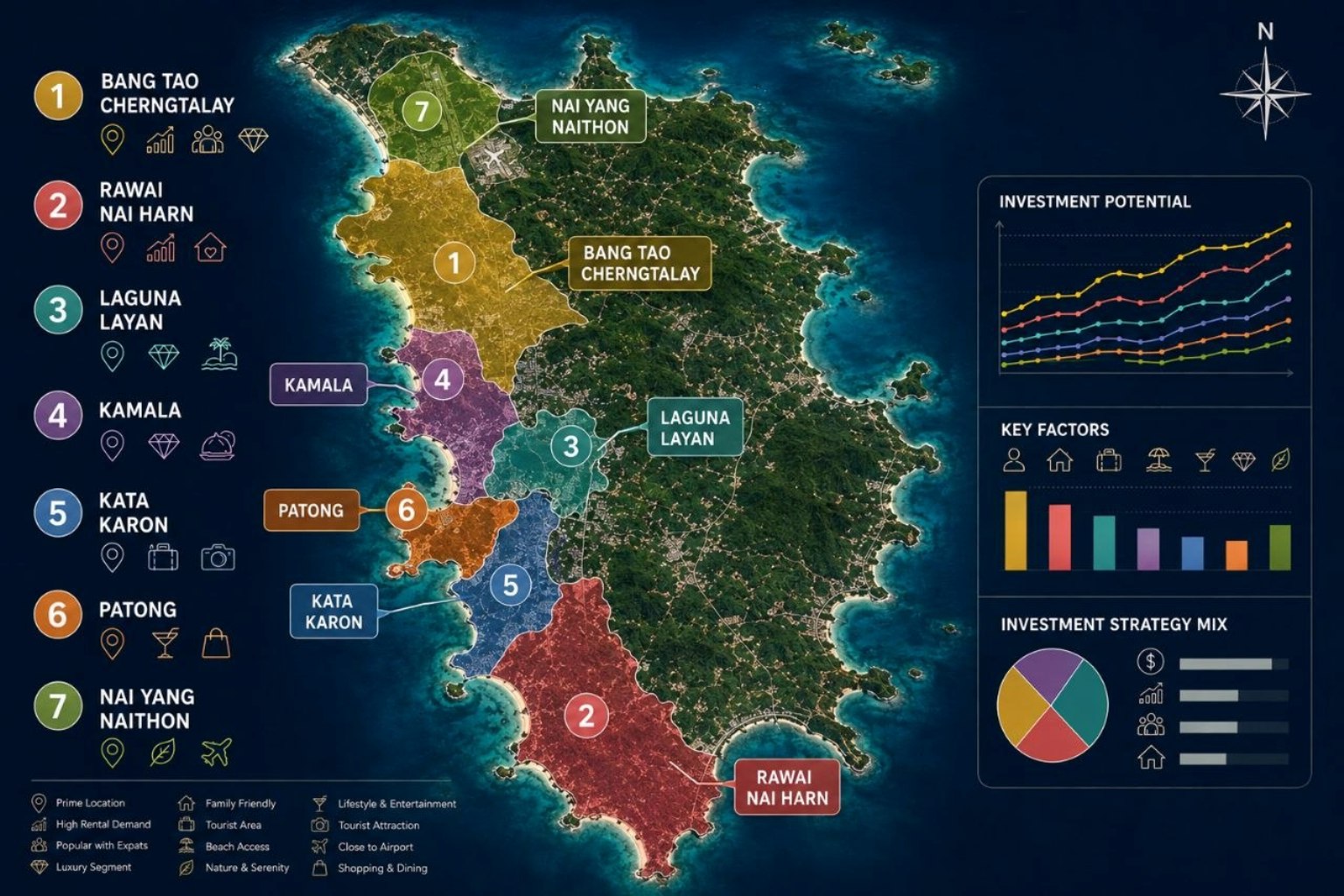
Which Areas of Phuket Are Best for Retirees?
Choosing a location for retirement is different from choosing property purely for tourist rental.
Rawai & Nai Harn — a relaxed atmosphere, a large international community, cafés, shops and convenient everyday infrastructure.
Bang Tao & Cherngtalay — modern infrastructure, restaurants, shopping, beaches and many new residential developments.
Kamala — suitable for those who want to live near the sea while enjoying a quieter atmosphere.
Laguna & Layan — a premium segment with high-quality infrastructure and luxury properties.
Nai Yang — a quieter area with the additional advantage of being close to Phuket International Airport.
For retirees, distance to the beach is not the only consideration. Healthcare, pharmacies, supermarkets, restaurants, transportation and everyday convenience can be just as important.
How Much Money Do You Need?
It is important to separate visa financial requirements from the actual cost of living.
For retirement visa categories, the financial threshold may start from approximately 65,000 THB in monthly income or an 800,000 THB bank deposit. Long-term programs can require significantly higher amounts.
The actual cost of living depends on your lifestyle: renting or owning property, food, transportation, healthcare insurance, entertainment and the area where you live.
Therefore, there is no single amount that guarantees a comfortable life in Phuket.
What Should You Do Before Moving?
A sensible approach is:
1. Determine the most suitable visa category.
2. Check the requirements for your citizenship.
3. Calculate your living budget and insurance costs.
4. Choose the right area.
5. Only then consider purchasing real estate.
For many retirees, Phuket becomes a new home rather than simply a place to escape the winter.
Real estate can become part of a long-term lifestyle and financial strategy.
That is why, when buying property, it is important to consider not only the price and proximity to the sea, but also the quality of the area, infrastructure, property liquidity and the possibility of using the property as a home or an additional source of income.
Visa requirements may change. Always check the latest conditions with the relevant Thai authorities before applying.